
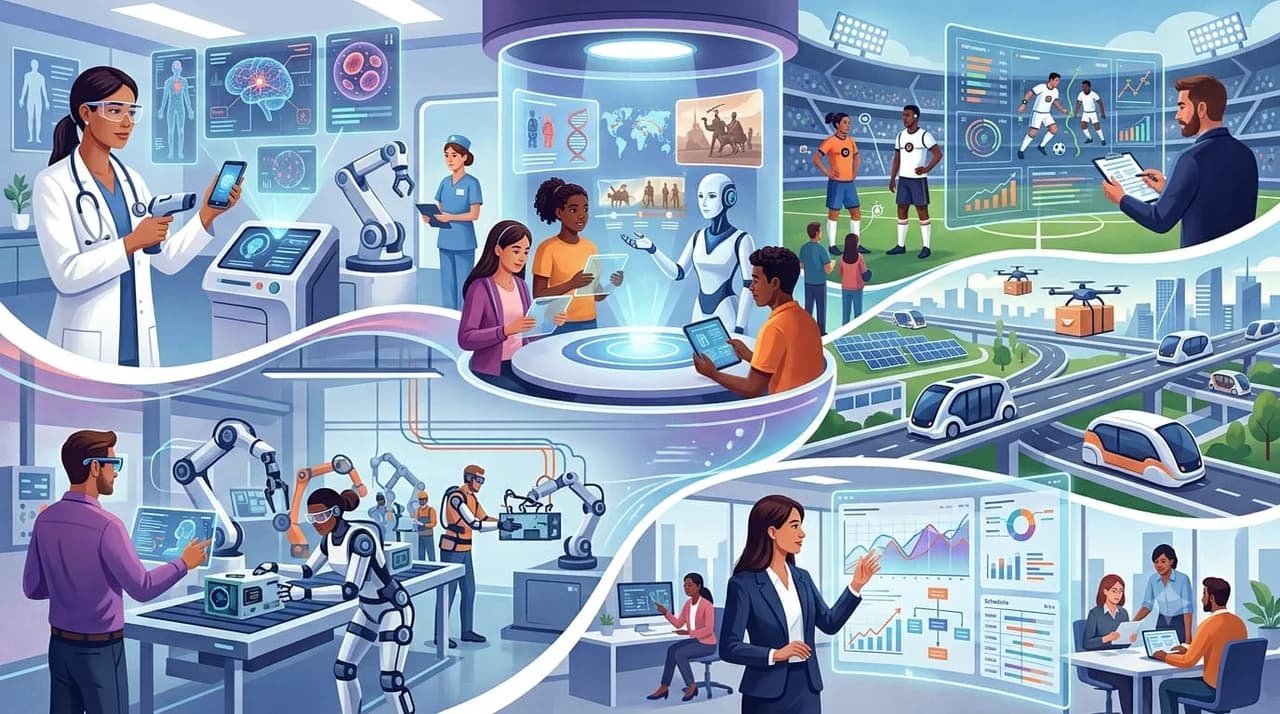
AI by 2030: How Artificial Intelligence Could Transform Our Lives
Artificial Intelligence is no longer a technology limited to research laboratories. It is already becoming part of everyday life, from smartphones and search engines to healthcare, education, business, entertainment, and sports.
But how far could AI go by 2030? And how could it change the way people live, work, learn, communicate, and create?
While nobody can predict the future with complete certainty, the rapid development of generative AI, AI agents, robotics, automation, and machine learning suggests that the next few years could bring major changes across many areas of society.
AI in Everyday Life
By 2030, AI could become much more deeply integrated into the digital services people already use.
Instead of manually completing every small digital task, people could increasingly rely on intelligent assistants to organize schedules, summarize information, manage routine activities, recommend useful services, and help them make everyday decisions.
The biggest change may not be that people actively use AI all the time. Instead, AI could become part of the software and devices that people already use without them even thinking about it.
AI in Healthcare
Healthcare could become one of the most important areas for AI development.
AI systems are already being researched and used for medical imaging, drug discovery, patient monitoring, medical research, and administrative tasks. By 2030, AI could help healthcare professionals analyze large amounts of information more quickly and identify patterns that may be difficult to detect manually.
AI could also support more personalized healthcare by helping professionals understand individual patient data and potential risks.
However, AI is unlikely to eliminate the need for doctors and other healthcare professionals. Human judgment, responsibility, communication, and ethical decision-making will remain extremely important.
AI in Education
Education could also change significantly as AI becomes more accessible.
AI-powered learning assistants could provide students with personalized explanations, practice exercises, and educational support based on their individual learning needs.
A student struggling with a particular subject could potentially receive additional explanations and examples instead of simply moving on with the rest of the class.
Teachers could also use AI to prepare educational materials, organize information, analyze learning patterns, and reduce repetitive administrative work.
The major challenge will be ensuring that students use AI as a learning tool rather than allowing it to replace their own thinking.
AI and Jobs
The effect of AI on employment will likely remain one of the biggest discussions of the coming years.
Some repetitive tasks could become increasingly automated. AI may assist with activities such as data analysis, document processing, customer support, research, software development, and content creation.
At the same time, new jobs and industries could develop around AI, cybersecurity, robotics, data management, AI governance, and human-AI collaboration.
The future workplace may therefore be less about humans versus AI and more about humans working alongside increasingly capable AI systems.
AI in Software Development
Software development is already being transformed by AI coding tools.
Modern AI assistants can help developers write code, explain unfamiliar code, identify errors, generate tests, and create early prototypes.
By 2030, developers could spend less time manually writing routine code and more time designing systems, reviewing AI-generated work, solving complex problems, and making important architectural decisions.
This could also allow smaller teams and independent developers to build sophisticated software with fewer resources.
AI in Sports
Sports could become increasingly data-driven as AI becomes more capable.
AI systems can analyze player performance, movement, tactics, match footage, and other forms of sports data. In the future, coaches could receive more detailed insights during training and preparation.
AI could also help teams analyze potential players and identify performance patterns that might otherwise be difficult to notice.
For fans, AI could provide personalized statistics, match summaries, interactive experiences, and deeper analysis of games and players.
However, the human side of sport will remain important. Competition, teamwork, pressure, emotion, and unexpected moments are difficult to reduce to data alone.
AI in Transportation
Transportation could also experience major changes.
AI-powered driver assistance, autonomous vehicle technology, intelligent traffic systems, and automated logistics could make transportation more efficient and increasingly automated.
If autonomous vehicles become sufficiently reliable and widely accepted, they could change how people travel and how companies transport goods.
However, safety, infrastructure, regulation, cost, and public trust will play major roles in determining how quickly these technologies become widely adopted.
AI and Content Creation
Generative AI is already changing the way people create text, images, video, music, software, and other digital content.
By 2030, individuals may be able to create professional-quality digital content with relatively simple instructions and much smaller budgets.
A small business could create marketing materials without a large production team. An independent creator could produce videos, graphics, or educational content using AI-powered tools.
At the same time, society will need to deal with difficult questions involving copyright, ownership, misinformation, authenticity, and the growing difficulty of distinguishing real content from AI-generated material.
AI in Business
Businesses of all sizes could increasingly use AI to automate repetitive operations and provide more personalized services.
AI could help companies analyze customers, study markets, prepare reports, manage support requests, identify patterns, and assist employees with everyday tasks.
For small businesses, this could be especially significant. AI may allow a small team to perform work that previously required several specialized employees.
This could lower some barriers to starting and operating digital businesses.
AI and Cybersecurity
As AI becomes more powerful, cybersecurity will become even more important.
Security teams can use AI to analyze large amounts of security data, identify suspicious behavior, detect unusual patterns, and respond to certain threats more quickly.
However, attackers can also use AI to develop more sophisticated attacks.
This could create an ongoing technological competition between systems designed to defend digital infrastructure and systems designed to exploit it.
AI and Robotics
The combination of AI and robotics could be one of the most interesting developments of the next decade.
AI allows machines to understand information, while robots allow software intelligence to interact with the physical world.
More capable robots could eventually be used in factories, warehouses, agriculture, healthcare environments, and other workplaces.
Robots designed for general household use could also become more capable over time, although their widespread adoption will depend on cost, reliability, safety, and practical performance.
How AI Could Affect Ordinary People
The biggest impact of AI may not come from one dramatic invention.
Instead, millions of smaller improvements could gradually change everyday life.
People could have smarter digital assistants, more personalized education, improved healthcare tools, automated services, better accessibility, and new ways to work and create.
AI could also make certain professional capabilities available to people who previously could not afford them.
A small business owner could use AI for marketing and customer support. A student could use an AI tutor to understand difficult concepts. A creator could produce professional-looking digital content with a limited budget.
The Risks of an AI-Powered Future
The future of AI is not only about opportunities.
There are serious challenges involving privacy, misinformation, cybersecurity, copyright, employment, biased systems, and the concentration of technological power.
Trust could become another major issue.
As AI-generated images, videos, voices, and text become increasingly realistic, people may find it harder to determine whether information is genuine.
This means digital literacy, reliable sources, and independent verification could become increasingly important.
What Could AI Look Like by 2030?
By 2030, AI may not appear as one single revolutionary product.
Instead, it could become a general-purpose technology embedded throughout the digital world.
Search engines, smartphones, business software, healthcare systems, educational platforms, creative tools, vehicles, and robots could all use AI in different ways.
The biggest transformation may therefore not be about AI simply replacing humans. It could be about humans learning how to work effectively with increasingly capable AI systems.
The exact future remains uncertain. Some predictions will inevitably be wrong, while developments that seem unlikely today may become normal much faster than expected.
But one thing is already clear: AI is no longer just a technology of the future. It is already changing the present, and the next decade could determine how deeply it becomes part of everyday human life.



