
Camera-Free AI Smart Glasses: Why Privacy Is Reshaping the Future of Wearable AI
AI smart glasses are entering a new phase. Instead of competing only on cameras, displays and increasingly capable AI assistants, manufacturers are now dealing with a harder question: how can wearable AI become useful without making people around the wearer feel like they are being recorded?
That question became more important in September 2026, as Meta introduced its first camera-free AI glasses alongside a broader expansion of its smart-glasses lineup.
The new direction suggests that the future of wearable AI may not be defined by adding more sensors to glasses. It may instead depend on finding the right balance between AI capability, privacy, convenience and user control.
What Are Camera-Free AI Smart Glasses?
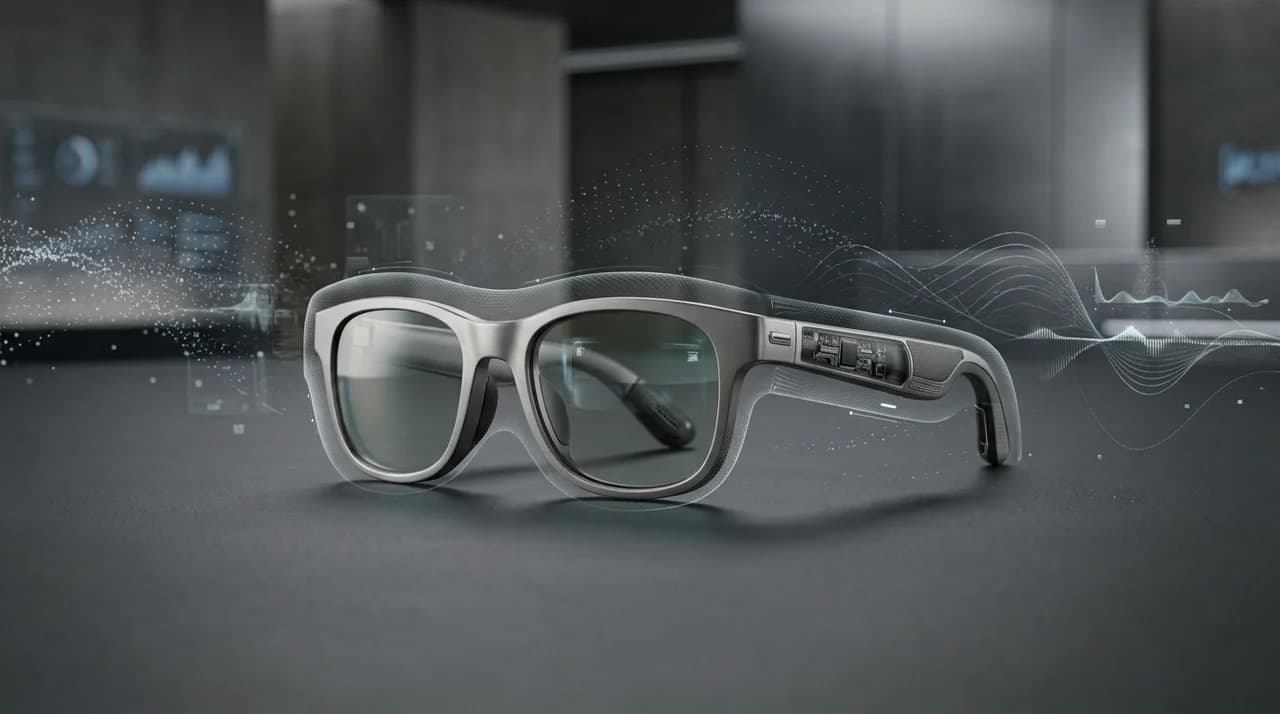
Camera-free AI smart glasses are wearable devices designed to provide AI and audio features without using an integrated camera.
Meta's newly announced Ray-Ban Meta Audio glasses are an example of this approach. The glasses focus on features such as audio, calls, music, podcasts, translation and interaction with Meta's AI assistant, while removing the camera that has been central to privacy concerns surrounding AI eyewear.
Meta announced the glasses at its Connect 2026 event, with pricing starting at $349.
The concept is relatively simple: keep the hands-free benefits of wearable AI while removing one of the most controversial sensors.
Why Are Camera-Free Glasses Becoming Important?
The privacy debate around AI glasses is not new, but it has become more significant as these devices become more capable.
Camera-equipped glasses can capture images and video from the wearer's point of view. That can be useful for documenting events, getting visual assistance and interacting with AI systems that understand the user's surroundings.
However, the same capability creates a difficult privacy question: what happens to people who are captured without knowing it?
Reuters reported in September that privacy concerns surrounding AI wearables are growing, particularly around covert recording and the collection of information about people who have not consented to being recorded.
The UK's Information Commissioner's Office has also highlighted broader concerns involving privacy, surveillance, safety and public trust as smart glasses become more common.
This means privacy is becoming part of the product design itself rather than simply a legal or regulatory issue.
Camera-Free Does Not Mean Completely Private
Removing the camera solves one major problem, but it does not make a wearable device automatically private.
AI glasses can still contain microphones, wireless connectivity and other sensors. Depending on how the software works, voice commands and other information may still be processed locally or sent to cloud-based AI systems.
This distinction matters.
A camera-free device can reduce the possibility of visual recording, but users still need to understand:
What information the glasses collect
When microphones are active
Which processing happens on the device
Which data is sent to the cloud
How long information is retained
Whether data can be used to improve AI systems
What controls users have over their information
Privacy therefore depends on the complete architecture of the product, not simply whether a camera is present.
Meta Is Also Investing in Private AI Processing
Meta has separately described a system called Private Processing for its AI glasses.
According to Meta's engineering team, more advanced AI functions can require cloud computing because the models and contextual information needed for those features are too large to run entirely on lightweight glasses.
Meta says its Private Processing architecture uses confidential computing to process certain AI workloads while attempting to keep personal information protected from access by the infrastructure operator.
This is an important technical direction because future AI glasses will likely need both local and cloud computing.
Simple functions can potentially happen on the device, while more demanding AI tasks can use remote computing.
The challenge is making that cloud connection trustworthy enough for users to allow an AI assistant to process increasingly personal information.
The Real Competition May Be Trust
The smart-glasses market is often described as a hardware competition.
Companies compete on:
Battery life
Weight
Audio quality
Camera quality
Display technology
AI assistants
Design
Price
But wearable AI introduces another competitive factor: trust.
A smartphone is normally visible when someone is using its camera. Smart glasses are different because the device sits on the user's face and can potentially operate without requiring the user to hold anything.
That creates a different social environment.
Meta already uses a visible capture LED on its camera-equipped AI glasses to indicate when photos or video are being captured. Meta says its glasses can also disable the camera if the capture LED is blocked or tampered with.
Those measures demonstrate the industry's attempt to make recording more visible, but camera-free glasses take a different approach: instead of trying to make the camera safer, they remove it entirely.
Will Camera-Free AI Glasses Replace Camera-Based Models?
Probably not in every use case.
Camera-equipped AI glasses provide capabilities that audio-only glasses cannot easily reproduce.
For example, cameras can enable AI systems to understand visual information, identify objects, interpret scenes and provide visual assistance.
A camera-free design sacrifices some of those capabilities in exchange for a simpler privacy proposition.
That creates two distinct product directions.
Camera-equipped AI glasses
These can offer:
Visual AI assistance
Photos and video
Scene understanding
Visual translation
Hands-free documentation
More context for AI assistants
But they also introduce greater privacy considerations.
Camera-free AI glasses
These can focus on:
Voice-based AI
Calls
Music and podcasts
Audio notifications
Translation
Hands-free interaction
A more privacy-conscious design
But they have less visual context available to the AI.
The important point is that neither design automatically solves every privacy problem. They represent different compromises.
Why This Matters for the Future of AI
The bigger story is not simply about glasses.
Technology companies are increasingly exploring devices that allow AI assistants to remain available throughout the day.
Smart glasses, AI pins, wearable recorders and small AI devices all follow a similar idea: the user should not have to constantly reach for a smartphone.
That could make AI more natural and useful.
But it also means AI systems may receive more information about the user's environment, conversations, location and activities.
The more context an AI assistant has, the more useful it can potentially become.
At the same time, the amount of information that needs to be protected also increases.
That creates a fundamental design challenge for wearable AI:
The AI needs context to become useful, but users need control over that context to trust the AI.
Local AI Could Become More Important
One possible solution is greater on-device AI processing.
Running more AI functions locally can reduce the amount of personal information that needs to leave the device.
However, there is a technical limitation.
Large AI models require substantial computing power, memory and energy. A pair of lightweight glasses cannot currently provide the same computing resources as a smartphone, PC or cloud data center.
This means future wearable AI systems are likely to use a hybrid architecture:
Local processing for sensitive or lightweight tasks + secure cloud processing for computationally intensive tasks.
The quality of that architecture could become just as important as the hardware itself.
What Consumers Should Check Before Buying AI Glasses
Consumers should not judge AI glasses solely by camera specifications, battery life or the quality of the AI assistant.
Before buying an AI wearable, users should also examine:
Camera and microphone controls
Understand when sensors are active and how recording is indicated.Local versus cloud processing
Check which AI functions happen on the device and which require remote servers.Data retention
Look for information about how long voice, images or other data are stored.Privacy controls
Check whether users can delete stored information and control AI data usage.Recording indicators
A visible recording indicator can help people nearby understand when content is being captured.Software permissions
Review which phone permissions the companion application requires.AI data policies
Read how the manufacturer handles information submitted to its AI assistant.
These factors can matter more over the long term than a small difference in hardware specifications.
The Future of Smart Glasses May Be Less About Cameras
The latest developments suggest that smart glasses are evolving beyond the idea of simply putting a camera on a pair of glasses.
The next generation could become a collection of different products.
Some users may want camera-equipped glasses capable of visual AI.
Others may prefer lightweight camera-free glasses focused on audio and voice assistants.
More advanced users could eventually choose devices with stronger local AI processing and greater control over personal data.
That means the future of smart glasses may not be one universal design.
Instead, manufacturers could build different types of AI eyewear for different levels of privacy, functionality and AI capability.
Final Takeaway
Camera-free AI smart glasses represent an important shift in wearable technology.
Their significance is not simply that manufacturers can build glasses without cameras. The bigger development is that privacy is becoming a core product requirement for AI hardware.
As AI assistants become more capable of understanding their users and surroundings, consumers will have to decide how much contextual information they are comfortable sharing.
For manufacturers, the challenge is even clearer: making AI glasses useful is only half the problem. Making them trustworthy enough for everyday use may determine whether wearable AI becomes a mainstream computing platform.
The next stage of smart glasses will therefore be shaped by more than better AI.
It will be shaped by privacy, transparency, local processing, security and user control.



