
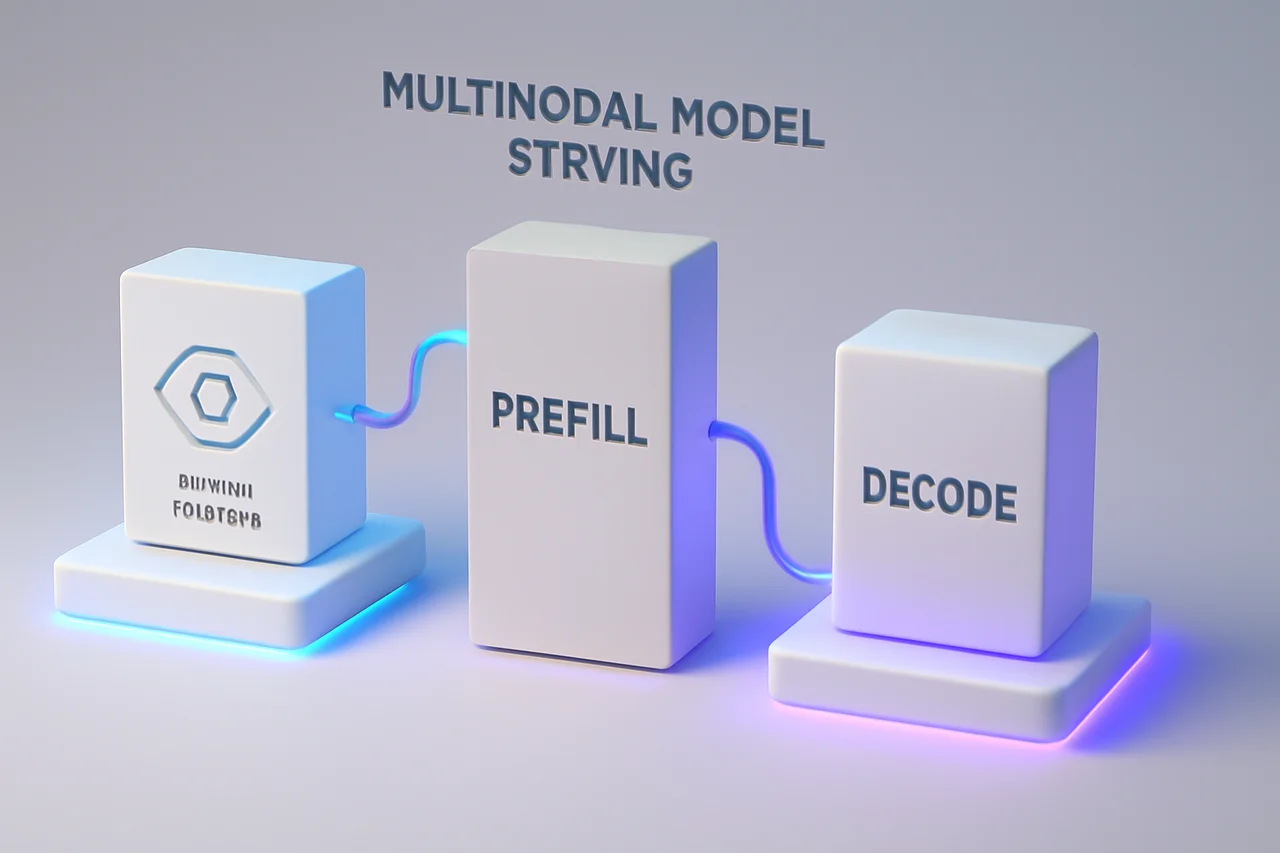
The rapid evolution of artificial intelligence has led to the development of increasingly complex multimodal models that can process and analyze diverse types of data, such as text, images, and audio. However, serving these models efficiently, especially in real-time applications, poses significant challenges. NVIDIA's latest exploration into the Encode-Prefill-Decode (EPD) disaggregation technique offers a promising solution to optimize inference for these models, particularly when coupled with their NVIDIA Dynamo platform.
What is Encode-Prefill-Decode Disaggregation?
Encode-Prefill-Decode disaggregation is an innovative approach to inference optimization tailored for multimodal models. This method decouples the vision encoder from the prefill and decode stages of the model, allowing for more efficient processing. By isolating these components, EPD can significantly enhance performance, particularly in scenarios that involve image-heavy prompts or require short-to-medium output responses. This separation not only streamlines the computational process but also allows for a more flexible architecture that can adapt to varying input types and processing needs.
Benefits of EPD Disaggregation
The primary advantage of using EPD disaggregation lies in its ability to streamline the processing pipeline of multimodal models. This technique is especially beneficial for:
- Image-Heavy Prompts: EPD excels in situations where the input primarily consists of visual data, ensuring that the model can handle these types of requests efficiently. This capability is crucial in applications such as autonomous driving, where rapid image analysis is essential for decision-making.
- Short-to-Medium Outputs: For applications requiring quick and concise responses, EPD disaggregation allows for faster turnaround times. This is particularly advantageous in customer service chatbots, where immediate responses can enhance user experience.
- Quantized Mixture-of-Experts Models: The technique is particularly effective when used with quantized MoE, which can further enhance performance and reduce computational overhead. This synergy allows for a more efficient allocation of resources, enabling models to scale effectively in environments with limited computational power.
Integrating EPD with NVIDIA Dynamo
NVIDIA Dynamo serves as a powerful framework for implementing EPD disaggregation. By leveraging the capabilities of this platform, developers can optimize their multimodal models to achieve significant performance boosts. The integration process involves configuring the model architecture to separate the vision encoder from the subsequent stages, thereby allowing for a more flexible and efficient inference process. This modularity not only improves performance but also facilitates easier updates and modifications to the model, enabling developers to adapt to new requirements or data types swiftly.
Performance Improvements
One of the standout features of EPD disaggregation is its potential to enhance performance by up to five times in certain applications. This improvement can be particularly transformative for industries relying on real-time data processing, such as healthcare, finance, and entertainment. In healthcare, for instance, faster image processing can lead to quicker diagnoses, while in finance, rapid data interpretation can significantly impact trading decisions. By adopting this technique, organizations can not only improve response times but also reduce the computational resources required for model inference, leading to cost savings and increased efficiency.
Use Cases for EPD Disaggregation
Several practical applications can benefit from EPD disaggregation. For instance:
- Image Recognition: In sectors like retail, where quick image analysis is crucial for inventory management and customer engagement. Retailers can leverage EPD to enhance their visual search capabilities, allowing customers to find products more efficiently.
- Content Generation: In creative industries, where generating visual content based on textual prompts can be accelerated. This can empower artists and marketers to produce high-quality visuals in a fraction of the time.
- Real-Time Analytics: In finance, where rapid data interpretation can lead to better decision-making. Financial analysts can utilize EPD to process large datasets quickly, enabling them to respond to market changes in real-time.
Conclusion
As the demand for efficient multimodal model serving continues to grow, techniques like Encode-Prefill-Decode disaggregation represent a significant advancement in optimizing inference. By separating the vision encoder from the prefill and decode stages, developers can enhance the performance of their models, especially when used in conjunction with NVIDIA Dynamo. This optimization not only leads to faster processing times but also allows for more complex applications in various industries, paving the way for the next generation of AI-driven solutions. As organizations increasingly rely on AI for critical operations, the ability to efficiently process multimodal data will be paramount, making EPD disaggregation a key technology in the future landscape of artificial intelligence.
Key Highlights
- EPD disaggregation optimizes inference for multimodal models by separating stages.
- Best suited for image-heavy prompts and short-to-medium output requests.
- Integrating EPD with NVIDIA Dynamo can significantly enhance model performance.
- Performance improvements can reach up to 5x in certain applications.
- Ideal for sectors requiring real-time data processing, such as healthcare and finance.
Expert Analysis
Technical Analysis
The Encode-Prefill-Decode (EPD) disaggregation technique is a novel approach designed to optimize the inference process for multimodal models, which can handle various types of data, including text, images, and audio. By decoupling the vision encoder from the prefill and decode stages, EPD allows for a more efficient processing pipeline. This separation enhances performance, particularly in applications that involve image-heavy prompts or require quick, concise outputs. The flexibility of this architecture enables it to adapt to different input types and processing needs, addressing the challenges of real-time applications.
One of the key technical improvements offered by EPD disaggregation is its synergy with quantized mixture-of-experts (MoE) models, which can further enhance performance while reducing computational overhead. This combination allows for efficient resource allocation, making it particularly beneficial in environments with limited computational power. However, while EPD disaggregation shows promise in improving performance by up to five times in certain applications, its effectiveness may vary depending on the specific use case and the complexity of the multimodal model being utilized.
Advantages
- Significantly enhances performance for image-heavy prompts, crucial for applications like autonomous driving.
- Reduces turnaround times for short-to-medium outputs, beneficial for customer service chatbots.
- Works effectively with quantized mixture-of-experts models, improving resource allocation and efficiency.
- Facilitates easier updates and modifications to model architecture, allowing for swift adaptation to new requirements.
- Can lead to cost savings by reducing the computational resources required for model inference.
Disadvantages
- No major disadvantages reported yet.
Real-World Use Cases
- Image recognition in retail for efficient inventory management and customer engagement.
- Content generation in creative industries, enabling faster production of high-quality visuals.
- Real-time analytics in finance for quick data interpretation and improved decision-making.
Business Impact
The introduction of EPD disaggregation is poised to significantly impact industries that rely on real-time data processing, such as healthcare, finance, and entertainment. By optimizing multimodal model serving, businesses can expect improved response times and reduced operational costs, creating new revenue opportunities. Additionally, as organizations increasingly adopt AI technologies, those leveraging EPD disaggregation may gain a competitive edge in their respective markets, potentially reshaping industry standards for efficiency and performance.
Competitors in the AI space may need to respond by enhancing their own model serving capabilities to keep pace with the advancements brought about by NVIDIA's EPD disaggregation. This could lead to increased innovation across the sector as companies strive to improve their offerings and meet the growing demand for efficient AI solutions.
User Impact
Ordinary users stand to benefit from the advancements brought by EPD disaggregation, particularly in applications that require rapid responses, such as customer service chatbots and image recognition tools. These improvements can enhance user experience by providing faster and more accurate results. However, users may not be directly aware of the underlying technology; their primary concern will be the efficiency and effectiveness of the services they use. Overall, the adoption of EPD disaggregation appears to be worth considering for organizations looking to enhance their AI capabilities and improve user satisfaction.
Security & Privacy
Security and privacy analysis not applicable.
Future Outlook
In the near term, we can expect further developments in the application of EPD disaggregation as more organizations adopt NVIDIA's Dynamo platform. As the demand for efficient multimodal model serving continues to rise, improvements in the architecture and integration of EPD with other AI technologies may emerge. Additionally, advancements in quantized mixture-of-experts models could further enhance performance and resource efficiency, paving the way for broader adoption across various industries.
Expert Summary
The exploration of EPD disaggregation by NVIDIA represents a significant advancement in optimizing multimodal model serving, addressing the growing need for efficient AI solutions. Organizations across various sectors should pay attention to this technology, as it has the potential to enhance performance and reduce costs in real-time applications. Overall, EPD disaggregation is a noteworthy development that could shape the future landscape of artificial intelligence.
Originally reported by NVIDIA Technical Blog.



