
AI Agents 2026: How Autonomous AI Is Transforming Business and Daily Life
Introduction
2026 is shaping up to be a defining year for technology. For the past few years, artificial intelligence (AI) was mostly known for answering questions or generating text. Now, AI has entered a new phase widely referred to as AI Agents or Agentic AI — systems that don't just think, but act independently to complete real-world tasks. These agents can manage business workflows, book services, respond to emails, analyze complex data, and execute multi-step decisions without constant human supervision.
Industry leaders and research firms are calling 2026 the "Year of Truth for AI," meaning the focus has shifted from experimentation to measurable, real-world impact. In this article, we break down what AI Agents actually are, how they work, where they're already being used, and what benefits and challenges come with them.
What Are AI Agents?
In simple terms, an AI Agent is a software system powered by large language models that can:
- Understand a goal or instruction
- Independently plan the steps needed to achieve it
- Use tools, apps, or APIs to carry out those steps
- Complete tasks with minimal ongoing human input
This is different from a traditional chatbot. A chatbot answers a question. An AI Agent takes action — it can make a purchase, plan a trip, or run an entire business process from start to finish.
How Do AI Agents Work?
Most AI Agents operate through four core stages:
- Perception — The agent interprets the instruction and gathers relevant context.
- Planning — It breaks the goal down into a sequence of achievable steps.
- Action — It executes those steps using available tools, software, or APIs.
- Reflection — It evaluates the outcome and adjusts if the goal hasn't been fully met.
This loop of independent planning and execution is what separates AI Agents from traditional automation, which only follows fixed, pre-programmed rules.
Real-World Business Applications
AI Agents are already being adopted across multiple industries in 2026:
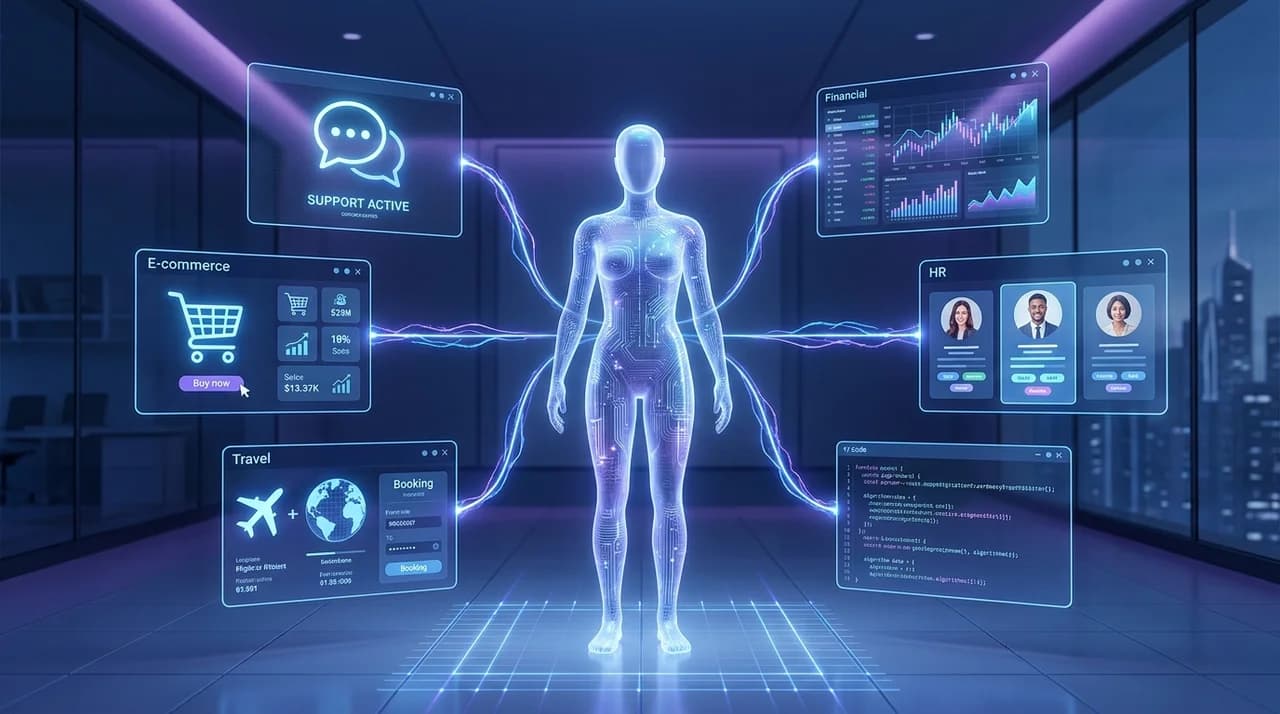
- Customer Service — Handling entire support conversations and resolving issues autonomously
- E-commerce — Managing purchases, negotiations, and order processes
- Travel & Logistics — Planning trips, booking, and scheduling automatically
- Finance — Running data analysis, reporting, and risk assessment
- Human Resources — Supporting recruitment, interview scheduling, and employee queries
- Software Development — Writing code, running tests, and identifying bugs
While adoption is still growing, analysts expect AI Agents to become a standard part of enterprise architecture as the technology matures.
Key Benefits
- Faster task completion and improved efficiency
- Reduced human error
- 24/7 availability with no downtime
- Lower operational costs
- Ability to handle complex, multi-step tasks autonomously
Challenges and Concerns
- Data Security & Privacy — Autonomous agents often need access to sensitive systems and data, requiring strict security protocols.
- Governance — Effective AI governance — including usage policies and a "human-in-the-loop" approach — is becoming essential to manage risk.
- Trust — Full autonomy means some decisions still require human oversight before they're finalized.
- Workforce Impact — As routine tasks become automated, the skills required in the job market are shifting.
What's Next?
According to major research and technology firms, AI Agents are expected to become the backbone of enterprise IT infrastructure in the coming years. Combined with advances like edge AI and next-generation computing, these agents will only become smarter and more capable. Many experts believe 2026 is just the starting point — and that autonomous AI will soon become as embedded in daily life as smartphones are today.
Conclusion
AI Agents represent more than a passing trend — they mark a fundamental shift in how technology interacts with the real world. Businesses that understand and adopt this shift early will be better positioned for the future, while those that wait risk falling behind. Now is the time to understand AI Agents and start building a strategy around them.



