
NVIDIA History: From a 1993 Startup to the AI Era
SEO Title: NVIDIA History: From 1993 Startup to AI Powerhouse
Slug: nvidia-history-from-1993-to-ai-era-2026
Meta Title: NVIDIA History 1993–2026: GPU, CUDA, AI & Rubin
Meta Description: Discover NVIDIA's complete journey from its 1993 founding and GeForce breakthrough to CUDA, AI, RTX, Blackwell and Vera Rubin in 2026.
Excerpt: NVIDIA started as a small graphics-chip company in 1993 and evolved into one of the world's most important accelerated-computing and AI infrastructure companies. Explore its major breakthroughs, challenges, acquisitions and technology shifts from 1993 to 2026.
Primary Keyword: NVIDIA history
Secondary Keywords: NVIDIA history 1993 to 2026, NVIDIA founders, Jensen Huang, NVIDIA GPU history, GeForce history, CUDA history, NVIDIA AI history, NVIDIA RTX history, NVIDIA Blackwell, NVIDIA Vera Rubin, NVIDIA data center
Tags: NVIDIA, NVIDIA History, Jensen Huang, GPU, GeForce, CUDA, Artificial Intelligence, AI, RTX, Blackwell, Vera Rubin, Data Center, Semiconductors, Technology, Accelerated Computing
Category: AI & Machine Learning
NVIDIA's Complete History: From a 1993 Graphics Startup to the AI Era
NVIDIA is no longer simply a company that makes graphics processors.
Over more than three decades, NVIDIA has transformed from a small graphics-chip startup into a major force in accelerated computing, artificial intelligence, data centers, scientific computing, robotics and AI infrastructure.
But that transformation did not happen overnight.
The company's current position is the result of decades of technological bets, successful products, strategic acquisitions, major setbacks and several fundamental shifts in the way computers process information.
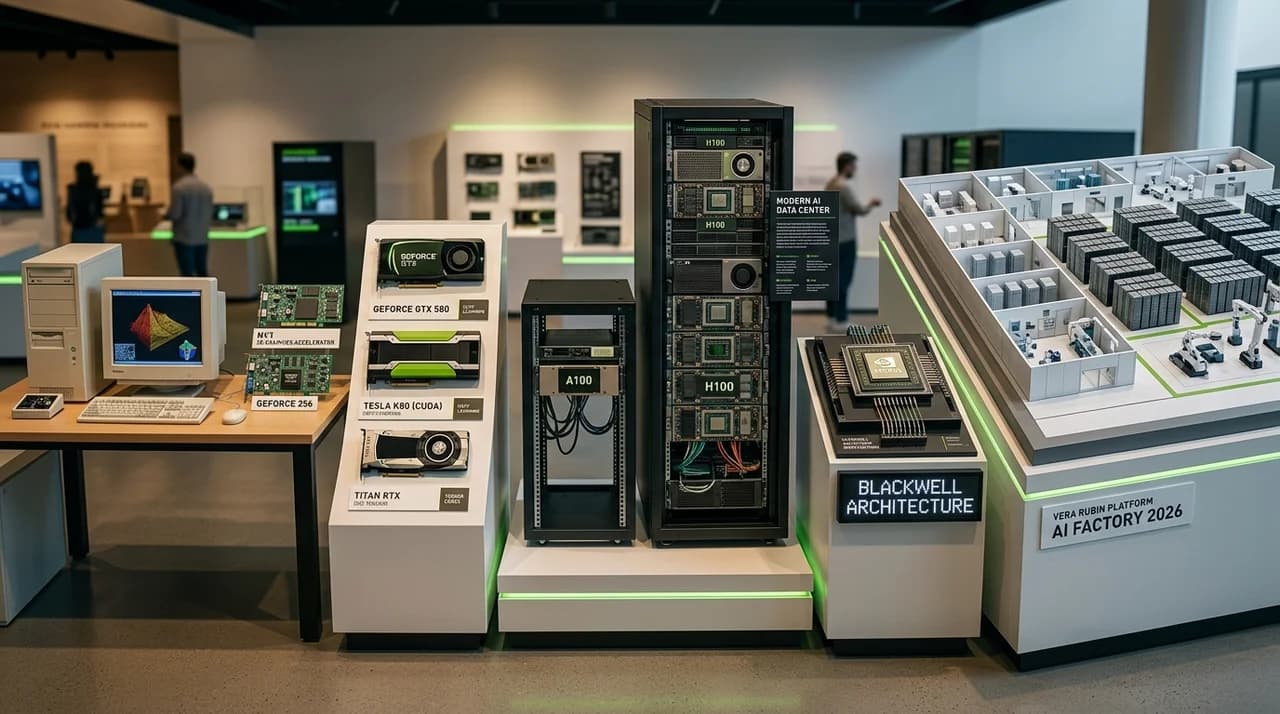
This is the story of NVIDIA from its founding in 1993 to the Vera Rubin era of 2026.
1993: The Beginning of NVIDIA
NVIDIA was founded on April 5, 1993, by Jensen Huang, Chris Malachowsky and Curtis Priem.
The company's original vision was focused on improving graphics and multimedia computing, particularly for the rapidly developing PC and gaming markets.
At the time, NVIDIA was just one of many young companies competing in the emerging graphics-chip industry.
There was no guarantee that it would become a global technology leader.
Its early mission was much narrower than the role it plays today: build better technology for computer graphics.
That initial focus would eventually become the foundation for something much larger.
1994: NVIDIA's First Strategic Partnership
In 1994, NVIDIA established a strategic partnership with SGS-Thomson Microelectronics.
The partnership was important because building successful semiconductor products required more than engineering.
NVIDIA needed manufacturing capabilities, distribution and relationships across the technology industry.
The company was beginning to build the ecosystem that would allow its graphics technology to reach commercial products.
1995: NV1 and NVIDIA's First Major Test
In 1995, NVIDIA introduced its first product, the NV1.
The NV1 was an ambitious graphics product designed for the emerging 3D gaming market.
It was also associated with Sega's Virtua Fighter, demonstrating NVIDIA's interest in bringing advanced 3D graphics technology to gaming.
However, NVIDIA's early history was far from a straight line of victories.
The graphics industry was highly competitive, technical standards were evolving rapidly, and compatibility with emerging software and games presented significant challenges.
NVIDIA had to prove that it could survive in an industry where technology could become obsolete very quickly.
1999: GeForce 256 and the Birth of the GPU Category
One of the biggest turning points in NVIDIA's history came in 1999.
NVIDIA introduced the GeForce 256 and promoted it as the world's first GPU, or Graphics Processing Unit.
The importance of this product went beyond a new graphics card.
NVIDIA was helping establish the idea that a processor specifically designed for massively parallel graphics workloads could become a fundamentally different type of computing engine.
This concept would eventually become critical far beyond gaming.
The GPU would evolve from a graphics processor into a powerful parallel-computing platform.
That transformation would later become the foundation of NVIDIA's AI strategy.
2000: 3dfx and the Xbox Era
In 2000, NVIDIA acquired the assets of 3dfx, one of the notable graphics technology companies of the era.
The acquisition strengthened NVIDIA's position in the graphics industry.
During the same period, Microsoft selected NVIDIA graphics technology for its original Xbox console.
These developments helped expand NVIDIA's presence beyond PC graphics and into major consumer technology platforms.
The 2000s: Moving Beyond Graphics
During the early 2000s, NVIDIA began thinking about the GPU differently.
Instead of treating GPUs exclusively as graphics processors, the company increasingly explored their ability to perform large numbers of calculations in parallel.
This was a crucial strategic direction.
Traditional CPUs were designed primarily for general-purpose sequential and moderately parallel workloads.
GPUs, by contrast, were becoming extremely powerful at processing large numbers of similar calculations simultaneously.
That capability would eventually prove ideal for scientific computing and artificial intelligence.
NVIDIA was effectively preparing for a computing revolution before the mainstream AI boom had arrived.
2006: CUDA Changes NVIDIA's Future
In 2006, NVIDIA introduced CUDA.
CUDA gave developers and researchers a way to use NVIDIA GPUs for general-purpose parallel computing rather than limiting them to graphics.
This was one of the most important decisions in NVIDIA's history.
The company's technology path began to change:
Gaming → Graphics → Parallel Computing → AI
CUDA created a software ecosystem around NVIDIA hardware.
Instead of selling only a piece of silicon, NVIDIA was increasingly building a computing platform that developers could program and build upon.
This software ecosystem would become one of the company's major long-term advantages.
2010: Fermi and GPU Computing
NVIDIA's Fermi architecture continued the company's transition toward general-purpose GPU computing.
The architecture was designed not only for graphics but also for demanding computational workloads.
During this period, GPUs were becoming increasingly important in scientific research, high-performance computing and other workloads requiring massive parallel processing.
The idea of using GPUs as accelerators was becoming increasingly mainstream.
2012: AlexNet and the Beginning of the Modern AI Revolution
The year 2012 became one of the most important moments in NVIDIA's history.
The AlexNet neural network achieved a major breakthrough in image recognition.
Importantly for NVIDIA, AlexNet used NVIDIA GPUs to accelerate deep-learning computations.
The achievement demonstrated something that would eventually transform the entire technology industry:
GPUs were exceptionally well suited to deep learning.
NVIDIA had spent years developing parallel computing and CUDA.
The AI revolution suddenly created an enormous real-world demand for exactly those capabilities.
This was the point where NVIDIA's long-term GPU strategy began intersecting directly with the rise of modern artificial intelligence.
Pascal, Volta and the Rise of AI Acceleration
NVIDIA continued developing increasingly specialized GPU architectures.
Pascal arrived in 2016, followed by Volta in 2017.
Volta introduced Tensor Cores designed to accelerate AI and deep-learning workloads.
This was another major shift.
NVIDIA was no longer simply adapting gaming GPUs for AI.
The company was increasingly designing hardware specifically around the mathematical operations required by machine learning.
The GPU was becoming an AI accelerator.
2018: RTX and Real-Time Ray Tracing
In 2018, NVIDIA introduced its RTX platform.
RTX brought dedicated hardware acceleration for real-time ray tracing to consumer graphics.
Ray tracing attempts to simulate how light interacts with objects, surfaces and environments.
The technology enabled more realistic reflections, lighting and shadows in supported applications and games.
RTX demonstrated that NVIDIA was continuing to innovate in its original graphics business even while the company's data-center and AI ambitions were expanding.
2019–2020: NVIDIA Moves Deeper Into Data Centers
As AI workloads became more demanding, NVIDIA's data-center business became increasingly important.
The company was no longer simply providing individual GPUs.
It was building a broader accelerated-computing ecosystem.
In 2019, NVIDIA announced an agreement to acquire Mellanox, and the acquisition was completed in April 2020.
Mellanox specialized in high-performance networking technology.
The acquisition strengthened NVIDIA's ability to connect large numbers of accelerators and processors inside data centers.
This was strategically important because large AI systems require more than powerful GPUs.
They also require extremely fast networking and communication between computing nodes.
2020: The Attempt to Acquire Arm
In 2020, NVIDIA announced a proposed acquisition of Arm from SoftBank in a transaction valued at approximately $40 billion.
Arm is one of the world's most important CPU architecture ecosystems.
However, the transaction faced regulatory challenges in multiple jurisdictions.
In February 2022, NVIDIA and SoftBank announced that the proposed acquisition would be terminated.
The deal therefore did not become part of NVIDIA's corporate structure.
Despite the failed acquisition, NVIDIA continued working with the broader Arm ecosystem.
The episode demonstrated that NVIDIA's ambitions had expanded well beyond GPUs.
2020: Ampere and the AI Data Center
NVIDIA introduced its Ampere architecture in 2020.
Ampere significantly advanced GPU acceleration for both graphics and AI workloads.
At the same time, NVIDIA continued building its data-center strategy around GPUs, networking and software.
The company was increasingly positioning itself as an accelerated-computing platform provider rather than simply a graphics-card manufacturer.
2022: Hopper and the Expansion of AI Computing
In 2022, NVIDIA introduced its Hopper architecture.
Hopper was designed primarily around large-scale accelerated computing and AI workloads.
The architecture helped NVIDIA target increasingly demanding AI training and inference systems.
The same era also saw NVIDIA expanding its Omniverse platform.
Omniverse was designed around 3D collaboration, simulation and digital-twin applications.
These efforts showed that NVIDIA was pursuing multiple computing markets while keeping accelerated computing at the center of its strategy.
The Generative AI Explosion
The launch of ChatGPT in late 2022 helped trigger a massive increase in public and commercial interest in generative AI.
Large language models require enormous computational resources for both training and inference.
NVIDIA's GPUs, CUDA ecosystem, networking technology and AI software stack became increasingly important infrastructure for this new generation of AI systems.
This was where years of NVIDIA's previous investments began connecting together.
The company had already developed:
GPU parallel computing
CUDA
Tensor acceleration
High-bandwidth memory technologies
High-performance networking
AI software libraries
Data-center platforms
The generative AI boom created enormous demand for this combination.
NVIDIA was increasingly becoming a full-stack AI infrastructure company.
2024: Blackwell
In March 2024, NVIDIA announced its Blackwell platform.
Blackwell was designed for advanced generative AI and accelerated computing workloads, including extremely large AI models.
The platform represented another shift in NVIDIA's strategy.
The focus was no longer simply on making an individual GPU faster.
Instead, NVIDIA was increasingly designing complete computing platforms involving GPUs, networking, software and large-scale systems.
Blackwell became a major part of NVIDIA's strategy for the rapidly expanding AI infrastructure market.
2025: The Rise of AI Factories
As AI systems became larger, NVIDIA increasingly described modern data centers as "AI factories."
The concept reflects a fundamental change in computing.
Traditional data centers primarily processed applications, databases and web services.
AI factories are designed to transform enormous amounts of data into trained models, predictions, generated content and other AI outputs.
This requires:
GPUs
CPUs
High-speed networking
Memory
Storage
Cooling
Software
Power infrastructure
Large-scale system integration
NVIDIA's strategy increasingly focused on providing many of these components as part of an integrated accelerated-computing platform.
2026: The Vera Rubin Era
In 2026, NVIDIA introduced the Vera Rubin platform as another major step in its AI computing roadmap.
The platform brings together multiple components, including the Vera CPU, Rubin GPU, NVLink networking technology, ConnectX networking, BlueField infrastructure processors and Spectrum Ethernet technology.
The direction is significant.
NVIDIA is no longer approaching AI computing as simply:
Buy a powerful GPU.
The broader strategy is:
Build an integrated AI computing system.
That includes compute, networking, communication, software and infrastructure.
NVIDIA's 2026 announcements around Vera Rubin also highlight the company's focus on increasingly advanced AI workloads, including agentic AI and large-scale scientific computing.
NVIDIA's Architecture Evolution
NVIDIA's technology history can also be viewed through its major GPU architecture generations.
The company progressed through generations including:
GeForce-era architectures
Tesla
Fermi
Kepler
Maxwell
Pascal
Volta
Turing
Ampere
Hopper
Ada Lovelace
Blackwell
Rubin
Each generation introduced different combinations of graphics, compute, AI acceleration, memory and networking capabilities.
The evolution demonstrates how NVIDIA gradually moved from a graphics-focused company toward a broader accelerated-computing platform.
NVIDIA's Biggest Strategic Transformation
NVIDIA's history becomes easier to understand when viewed as a series of transformations.
Transformation 1: Graphics
NVIDIA started by building technology for 3D graphics.
Transformation 2: GPU Computing
The company expanded the role of the GPU beyond graphics.
Transformation 3: CUDA
CUDA created a programmable software ecosystem around NVIDIA GPUs.
Transformation 4: AI Acceleration
Deep learning created a powerful new workload for NVIDIA's parallel processors.
Transformation 5: Data Centers
NVIDIA expanded from individual processors into large-scale computing systems.
Transformation 6: Full-Stack AI Infrastructure
With technologies such as networking, CPUs, GPUs, software and rack-scale systems, NVIDIA moved toward integrated AI infrastructure.
The overall progression can be summarized as:
Graphics → GPU → Parallel Computing → AI → Full-Stack AI Infrastructure
NVIDIA's Challenges and Setbacks
NVIDIA's history is not simply a list of successful products.
The company's early products faced significant technical and market challenges.
The semiconductor and graphics industries have always been highly competitive, with rapidly changing standards and strong rivals.
NVIDIA also experienced strategic setbacks.
Its proposed Arm acquisition was terminated in 2022 after regulatory challenges.
The company has also operated in markets where technology cycles can change rapidly and where enormous research and development investments are required.
The important point is that NVIDIA repeatedly changed its strategy when the computing landscape changed.
Why NVIDIA's History Matters
NVIDIA's story is important because it illustrates how a technology company can benefit from a long-term platform strategy.
The company did not know in 1993 that artificial intelligence would eventually become its biggest growth engine.
But NVIDIA spent years developing technologies around parallel computing.
CUDA helped create a software ecosystem.
Tensor Cores accelerated AI workloads.
Networking became essential for large AI clusters.
Data-center systems allowed those components to operate at enormous scale.
When modern AI workloads exploded, these technologies were already available.
That created a connection between decisions made years earlier and the AI infrastructure market of the 2020s.
NVIDIA in 2026
By 2026, describing NVIDIA simply as a "gaming GPU company" no longer captures the full scope of its technology strategy.
The company operates across a much broader computing ecosystem involving:
Artificial intelligence
Data centers
Accelerated computing
Gaming
Professional visualization
Scientific computing
Robotics
Autonomous systems
Networking
AI software
Large-scale AI infrastructure
The Vera Rubin generation represents another step toward integrated AI computing systems.
The NVIDIA Timeline: 1993–2026
1993 — NVIDIA is founded by Jensen Huang, Chris Malachowsky and Curtis Priem.
1994 — NVIDIA establishes an early strategic manufacturing partnership.
1995 — NVIDIA launches NV1.
1999 — GeForce 256 helps establish the GPU category.
2000 — NVIDIA acquires 3dfx assets and becomes involved in the original Xbox graphics platform.
2006 — CUDA launches and expands GPU computing beyond graphics.
2010 — Fermi advances GPU computing.
2012 — AlexNet demonstrates the importance of NVIDIA GPUs for deep learning.
2016 — Pascal arrives.
2017 — Volta and Tensor Cores accelerate AI workloads.
2018 — RTX brings real-time ray tracing to NVIDIA's graphics platform.
2020 — NVIDIA completes the Mellanox acquisition and launches Ampere.
2022 — The proposed Arm acquisition is terminated; Hopper launches.
2023 — Generative AI demand accelerates rapidly.
2024 — NVIDIA announces the Blackwell platform.
2025 — NVIDIA expands its AI factory and full-stack infrastructure strategy.
2026 — Vera Rubin becomes the next major phase of NVIDIA's accelerated-computing and AI platform roadmap.
Conclusion
NVIDIA's history is not simply the story of a company that built better graphics cards.
It is the story of a company that gradually changed the role of the GPU itself.
NVIDIA started with 3D graphics.
It moved into programmable parallel computing.
CUDA turned its hardware into a broader computing platform.
Deep learning transformed GPUs into critical AI accelerators.
Networking and data-center technologies expanded the company's reach.
Blackwell and Rubin pushed the strategy toward complete AI infrastructure.
The result is a remarkable technological progression:
1993: Graphics
1999: GPU
2006: CUDA
2012: Deep Learning
2018: RTX
2020: Data-Center Infrastructure
2024: Blackwell
2026: Vera Rubin
NVIDIA's next chapter will depend on how quickly AI computing continues to evolve, how efficiently massive AI systems can be built and operated, and how the company responds to increasing competition across chips, software and computing infrastructure.
But the journey from a three-person graphics startup in 1993 to a major AI computing platform in 2026 is already one of the most significant technology transformations of the modern computing era.



