
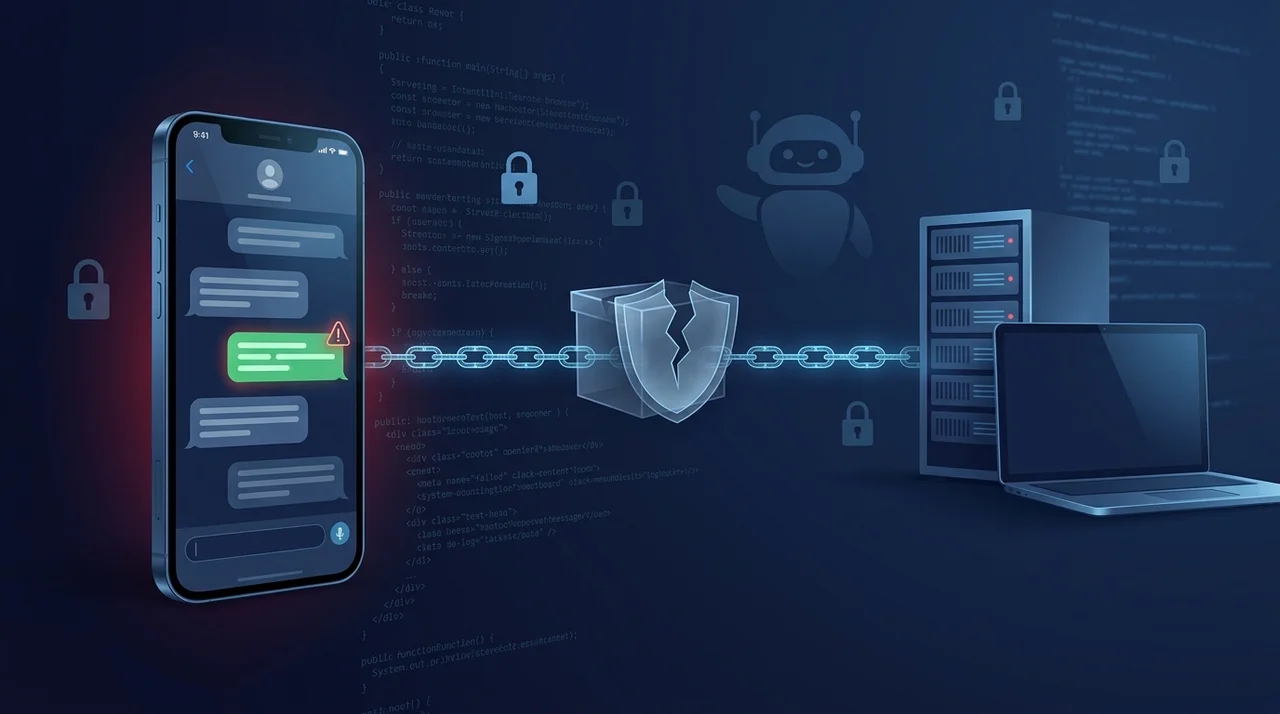
OpenClaw AI Assistant Flaws Let a WhatsApp Message Lead to Host Code Execution
Details have emerged about three now-patched security flaws in the OpenClaw personal artificial intelligence (AI) assistant. When chained together, the bugs could enable credential theft, privilege escalation, and arbitrary code execution on the host. Security researcher Chinmohan Nayak, who discovered and reported the issues, demonstrated that the attack path can begin with an external message sent via WhatsApp. This is a materially different threat model from earlier OpenClaw research, which assumed the attacker already had a foothold. The findings were first reported by The Hacker News.
Key Highlights
- Three high-severity OpenClaw flaws were patched in version 2026.6.6.
- The issues can be chained from an external WhatsApp message to host code execution.
- Two command-injection bugs carry a CVSS score of 8.8, and a bind-mount bypass is rated 8.4.
- Unlike the earlier Claw Chain research, no prior access to the target is required.
- OpenClaw maintainers and Nayak published hardening guidance alongside the fixes.
What OpenClaw Is, and Why Host Access Matters
OpenClaw is a personal AI assistant platform designed to help users automate tasks on their machines. Assistants in this category often bridge messaging channels, model reasoning, and local execution tools. That combination is powerful for productivity, but it also means a flaw that starts in an untrusted message can, in the worst case, reach the underlying host environment, where credentials, files, and system commands live.
The reporting frames the practical impact around operator configuration: can lower-trust input reach sensitive execution paths? For deployments that expose channel-facing agents with broad tool permissions, the distance between an inbound chat message and a host-level action can be shorter than operators assume. To understand this wider risk, read our guide on [INTERNAL: AI agent security risks].
The Three Vulnerabilities
All three flaws were fixed in OpenClaw version 2026.6.6. The maintainers released coordinated advisories describing the following issues:
- GHSA-hjr6-g723-hmfm (CVSS 8.8): An operating system command injection and an incomplete list of disallowed inputs in the host execution environment's filtering mechanism. Successful exploitation could allow actions beyond the caller's intended authorization to be executed or persisted.
- GHSA-9969-8g9h-rxwm (CVSS 8.8): A separate command injection and incomplete input-filtering flaw in the same filtering mechanism, reached through another code path, with the same authorization-bypass consequence.
- GHSA-575v-8hfq-m3mc (CVSS 8.4): A path traversal and link-following issue in sandbox bind mount handling. Blocked paths could be bypassed when parent directories were mounted, weakening the policy checks meant to keep sensitive host locations out of reach.
Individually, each advisory describes a serious defect. Chained together, they explain how a message arriving over WhatsApp could escalate into a host compromise instead of remaining contained inside the assistant's expected sandbox. For background, see our explainer on [INTERNAL: what is command injection].
From WhatsApp Message to Host Execution
Nayak's report, shared with The Hacker News, shows that the flaws can trigger host code execution from an external WhatsApp message. This matters because many AI assistant incidents are discussed as if attackers must already control part of the environment. Here, the entry point is an untrusted external channel.
The source reporting explicitly contrasts this with the Claw Chain vulnerabilities disclosed by Cyera in May, which were framed around scenarios requiring an established foothold. The newly identified bugs do not need that precondition to extract sensitive data, drop a persistent backdoor, obtain arbitrary remote code execution, or escape to the host.
For security teams evaluating agent deployments, the distinction is operational. A product may look safe in a controlled lab where only trusted operators interact with it, yet still be exposed once it is connected to consumer messaging surfaces.
How the Bind Mount Bypass Works
The path traversal issue is easier to understand through the researcher's explanation of the denylist logic. The function getBlockedReasonForSourcePath() checks whether a source path sits under a blocked path. It does not check the reverse, that is, whether a blocked path sits under the source. This creates a parent-directory bypass.
The bind mount denylist blocks directories such as ~/.ssh, ~/.aws, and ~/.gnupg, but it still allows mounting parent directories like /home or /var. Mounting /home into a container exposes every user's SSH keys, AWS credentials, and GPG secrets. Mounting /var can expose the Docker socket, which the reporting describes as a route to a full host escape from inside the sandbox.
This is a useful lesson for sandbox design in general: blocking leaf paths while permitting parent mounts can undo the intent of the blocklist entirely.
Mitigation and Hardening Guidance
The primary remediation is to update OpenClaw to version 2026.6.6 or later. Before upgrading, the advisories recommend restricting affected features to trusted operators or disabling them when they are not needed.
Additional hardening steps cited in the reporting include:
- Enable sandbox mode for all non-main sessions.
- Remove
execfrom the tool allowlist for channel-facing agents. - Monitor for
git clonecommands containing theext::external protocol helper, which could be abused to run arbitrary system commands. - Keep channel and tool allowlists narrow, avoid sharing one Gateway between mutually untrusted users, and disable affected features when they are not required.
These measures do not replace patching, but they reduce exposure for environments that cannot update immediately. For a broader checklist, see [INTERNAL: how to secure AI agents and sandboxes].
Why This Case Matters for AI Assistant Security
Personal AI assistants are moving from chat-only interfaces toward systems that can read files, run commands, and integrate with everyday messaging apps. Each new integration expands the attack surface. When execution tooling is enabled for convenience, a single malicious or manipulated message can become a remote administration attempt against the host.
The OpenClaw advisories are also a reminder that AI safety discussions cannot stop at model refusals. Host-side filtering, sandbox boundaries, and mount policy must be correct even when the model behaves as instructed. An assistant that dutifully follows a harmful request is still a security incident if the platform should never have allowed that request to reach execution. Related reading: [INTERNAL: prompt injection explained].
Conclusion
The WhatsApp-to-host attack chain against OpenClaw is a concrete example of how channel-connected AI agents can inherit messaging threat models traditionally associated with phishing and social engineering, then amplify them with local execution capability. The flaws are patched in 2026.6.6, but the configuration guidance remains relevant: treat external channels as untrusted input, limit tool permissions, and verify that sandbox rules block parent paths, not only leaf directories.
Originally reported by The Hacker News.



